
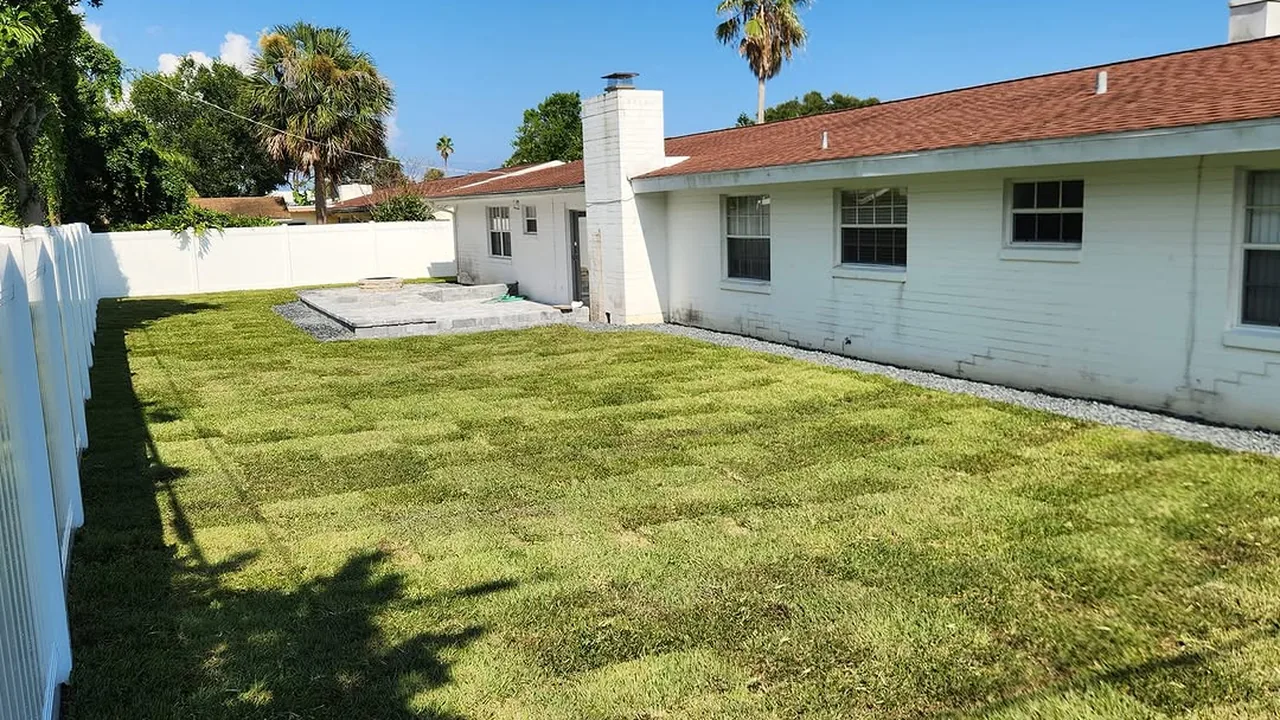
What Causes Yard Drainage Problems in Volusia County?
Many yards in Volusia and Flagler counties hold water because the ground is flat sand over a shallow water table. In most years, NRCS soil descriptions put it within 18 inches of the surface for 1 to 4 months. When the sand below is full, rain has nowhere to go but the low spots.
The fix depends on where the water sits. The ground gets regraded or raised with fill dirt, or the water gets a path out. That path can be a swale, a catch basin, a drainage pipe or a French drain. GBS Sod and Landscape does this yard grading and drainage work across both counties.
Why does the ground here hold water after rain?
Much of the coastal mainland is flatwoods, nearly level sandy ground. NRCS descriptions put Smyrna and Pomona sand, two common soils here, on slopes of 0 to 2 percent. UF/IFAS Extension says a lawn should fall 1 to 2 percent away from the house. On ground this flat, that fall often has to be built in.
The NRCS says the top layers of this sand let water through fast. The trouble starts when the water table rises into them. In rainy seasons, the Smyrna water table even rises above the surface for short spells.
By the National Weather Service’s median dates, the wet season at Daytona Beach runs May 30 to Oct. 15. NOAA’s 1991 to 2020 normals for the Daytona Beach airport show 51.25 inches of rain a year. June through September brings 26.7 inches of it, more than half.
Packed soil adds to the problem. UF/IFAS says traffic while a home is built often compacts the soil, which slows how fast water soaks in. On some lots, the ground also slopes toward the house, so every storm sends water to the foundation.
Does every town here drain the same way?
No. Wet flatwoods sand covers most of the coastal mainland, while ridge and dune sand drains fast. The table shows how much of each town’s land drains poorly and how much sits in a FEMA flood zone. Shares are rounded estimates from points sampled on NRCS soil maps and FEMA flood maps.
| Town | Most common soil | Poorly or very poorly drained | In a FEMA flood zone |
|---|---|---|---|
| Daytona Beach | Pomona | 87% | 50% |
| Palm Coast | Smyrna | 81% | 28% |
| Edgewater | Myakka | 77% | 32% |
| New Smyrna Beach | Pomona | 70% | 48% |
| Holly Hill | Tuscawilla and Myakka | 69% | 35% |
| Port Orange | Smyrna | 63% | 21% |
| Ormond Beach | Myakka | 61% | 32% |
Two places break the pattern. About 44 percent of DeLand’s land is excessively drained ridge sand, the driest NRCS class. About 79 percent of Ormond-by-the-Sea, on dune sand, is excessively drained. Only about 6 percent of either place is in a FEMA flood zone.
About 9 percent of Daytona Beach is Samsula muck. The NRCS puts its water table at or above the surface except in long dry spells. South Daytona’s most common soil, Tuscawilla, is very poorly drained. Flagler Beach has the most flood-zone land of the towns in this guide, about 53 percent.
On wet flatwoods ground, plan for a high water table each summer. On ridge and dune sand, standing water more often points to the grade or the sprinklers.
Is it a grading problem or an irrigation problem?
Water that pools in the same spot after rain points to the grade. A spot that stays wet on dry days points to the sprinklers. A UF/IFAS Extension county office lists these signs of a sprinkler leak:
- Sand swirls on the driveway or walk. A cracked pipe bubbles up when the system runs and pulls sand to the surface.
- Dollarweed in one patch. It thrives in wet ground, so one patch of it signals too much water there.
- Wet pavement on a dry day. Some heads are likely aimed wrong or damaged.
- Runoff before the water soaks in. If the heads aim right, the soil may be compacted.
Check the rain sensor too. The St. Johns River Water Management District requires one on automatic systems installed after May 1991. A system that runs in the rain can keep a lawn soggy.
Broken heads and cracked lines call for irrigation repair before any regrading. Some yards have both problems, so fix the leak first and then judge the grade.
How do you fix a yard that holds water?
Each fix below gives the water a way out.
- Regrading. The ground gets reshaped to fall away from the house. For big jobs, UF/IFAS says to set the topsoil aside and put it back after the rough grade.
- Downspouts. Ormond Beach’s flood page suggests pointing downspouts away from the house.
- Swales. New Smyrna Beach describes swales as shallow ditches shaped so water soaks in or flows away.
- Catch basins and drainage pipe. A grate at the low spot catches the water, and solid pipe carries it to a lower outlet.
- French drains. A French drain is a gravel trench around a perforated pipe that collects water along a wet strip. On flatwoods sand, it needs an outlet lower than the wet spot.
- Fill dirt. Fill raises a low spot so water runs off it. Larger low areas may need fill dirt delivered and spread.
Check the town’s rules before the ground changes. Palm Coast and Edgewater both bar grading that sends runoff onto the lot next door. Palm Coast requires a Lot Regrading Permit when heavy equipment does the work, tillers included.
Flagler Beach has a Change of Grade permit. In Daytona Beach and Edgewater, fill in a flood zone needs a permit. Elsewhere, ask the city building division, or the county outside city limits.
Who takes care of the swale out front?
The grassy swale by the road sits in the public right of way. The St. Johns River Water Management District says local governments maintain those drainage systems. Report a backed-up swale or a clogged culvert to the city or the county.
Flagler Beach asks owners to keep the swale mowed and never park in it. A parked car packs the soil, so water soaks in slower.
What should you check before new sod goes down?
Sod takes the shape of the ground under it, so fix the drainage first. Check these before the old lawn comes out:
- The grade. UF/IFAS calls for a fall of a half foot to a foot every 50 feet, away from the house. Walks and driveways should sit level with the final grade or slightly above it, with room for the sod’s thickness.
- Compaction. UF/IFAS suggests pushing a rod under an inch thick into moist soil. If it will not go 6 inches without real force, compaction will likely affect the grass.
- The sprinklers. UF/IFAS says irrigation goes in before the grass. Fix leaks while the ground is bare.
- Buried lines. Sunshine 811’s member utilities mark only their own lines. Show the crew where private sprinkler pipe and lighting cable run.
On a sod installation job, we tear out the old grass and weeds and grade the ground. Then we lay the new sod and water it in.
Who fixes yard drainage in Volusia and Flagler counties?
GBS Sod and Landscape is based in Ormond Beach and works across Volusia and Flagler counties. We regrade yards and cut swales. We also put in drainage pipe with grates and build French drains.
See our grading and drainage service for how a job runs. Then call or text (386) 238-9215. We look at the yard and put a free quote in writing.